


Description
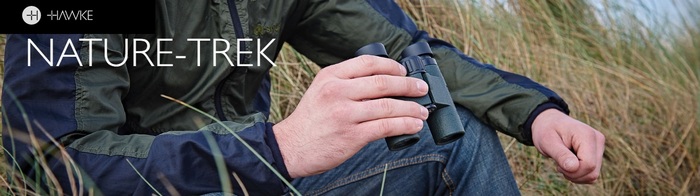
Hawke Nature Trek - these are, first of all, high-quality, reliable binoculars, mounted in a shock-resistant waterproof polycarbonate case, equipped with optics that significantly exceed the minimal capabilities of today's bright optical lenses adjusted. The wide model range of the Nature Trek line includes compact binoculars for hiking and great viewing for watching nature and birds, and binoculars with sufficient magnification and lens diameter for Beware of objects at a significant distance in low visibility. The articles would be closer to the world if only they had not risen in price.
 The highly spherical wide-smooth coating of Hawke optics, however, ensures high light transmittance across the entire visible spectrum and provides high contrast and color rendering in natural tones.
 BAK4 (barium crown) is a special type of optical glass, which is used for the production of prisms for optical devices. This material has a lower dispersion coefficient (light dispersion) and is less suitable for budget models. As a result, chromatic aberration is noticeably reduced (iris at sharp intervals between the transition from dark to light). In addition, a clear indicator of light bending allows you to eliminate vignetting (the phenomenon of trimming the light beam along the edges), which ensures uniform lightness of the image across the entire field of view.
 Waterproof - means that the optics are sealed with a reinforced O-ring and are protected from the penetration of moisture when enclosed in a length of 3 strands per depth of 1.5 meters. A static pressure at a depth of 1.5 meters does not affect the fit of the vehicle and does not affect its functionality. Such weather opinions are not scary.
 Fogproof - means that the body is filled with dry nitrogen N2 in the middle, which prevents condensation of moisture on the internal surfaces at a temperature gradient, daily fogging in the middle, and therefore does not cause corrosion of materials under the tide of water. The air is removed from the device and replaced with an inert gas (in this case, nitrogen N2), which does not allow water vapor in its storage and does not condense.
 Today, polycarbonate is increasingly being used for housings of optical devices. This material is completely justified by its minimal strength, chemical, thermal, mechanical resistance and ease of processing. Polycarbonate housings are lightweight and at the same time flexible. The stench does not attract additional expensive finishing treatment, such as anodizing or prefabricating.

