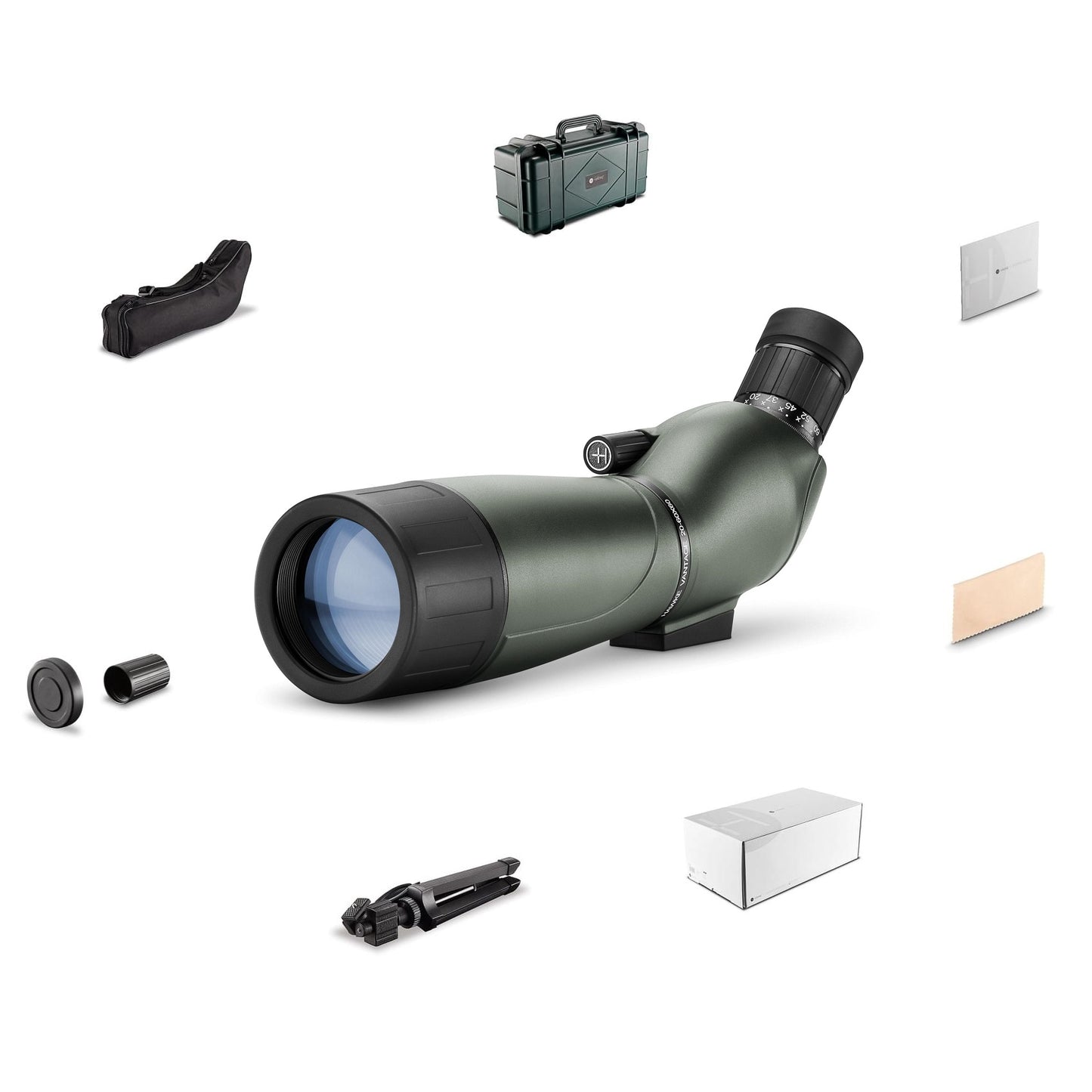
Description
Hawke Vantage spotters come with a full range of essential accessories, which is why they can be extremely difficult to use. Whatever you need to watch out for: whether it’s assessing hitting the target during sport shooting, fielding, astronomy, digiscoping, or just being careful around the area - the Hawke Vantage spotting scope will be the best. Wide functionality, high viscosity, low versatility, low varity - the axis of the main advantages of Hawke Vantage.

The optics of the telescope are coated with high-grade anti-reflective coatings and housed in a shockproof, waterproof polycarbonate housing. The middle of the housing is filled with nitrogen to eliminate condensation on the lenses.
The Hawke Vantage eyepiece extends at 45º in relation to the later axis of the tube - this is especially useful for guarding objects moved beyond the horizon, as well as when guarding a tripod. At the same time, the tripod that comes with the kit can be used as a tabletop one for greater ease of use. Some caution may be affected by the rotation of the tube in the clamp of the tripod adapter, which is why it becomes more difficult to be careful in the prone position. The visible sunshade will protect the lens not only from dreamy reflections, but also from specks.


 The highly spherical wide-smooth coating of Hawke optics, however, ensures high light transmittance across the entire visible spectrum and provides high contrast and color rendering in natural tones.
  Waterproof - means that the optics are sealed with a strong O-ring and are protected from the penetration of moisture by being enclosed in a core extending 3 lengths to a depth of 1.5 meters. The static pressure of the center at a depth of 1.5 meters does not affect the fit of the machine and does not affect its functionality. Such options are not scary in any weather mind.
 Fogproof - means that the body is filled with dry nitrogen N2 in the middle, which prevents condensation of moisture on the internal surfaces at a temperature gradient, daily fogging in the middle, and therefore does not cause corrosion of the materials the vologgers are pouring in. The air is removed from the device and replaced with an inert gas (in this case, nitrogen N2), which does not allow water vapor in its storage and does not condense.
 Today, polycarbonate is increasingly being used for housings of optical devices. This material is completely justified by its minimal strength, chemical, thermal, mechanical resistance and ease of processing. Polycarbonate housings are lightweight and shockproof. The stench does not attract additional expensive finishing treatment, such as anodizing or prefabricating.