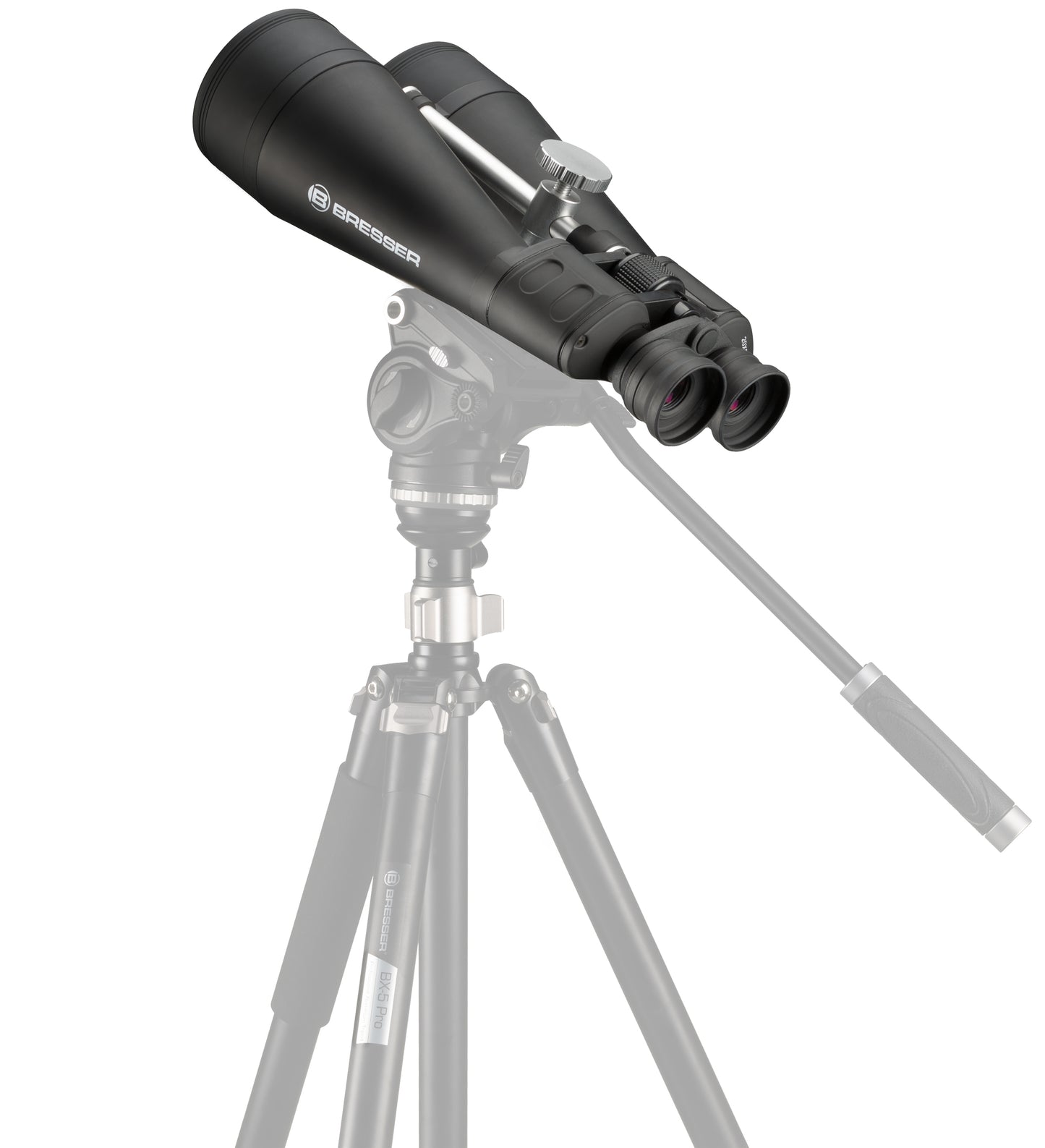
Description
BRESSER Spezial-Astro 20x80 is a powerful astronomical binoculars designed for observing the starry sky and distant terrestrial objects with exceptional clarity and detail. Thanks to the large objective diameter of 80 mm, the device collects a significant amount of light, which makes it an indispensable tool in twilight and night conditions. The large objective diameter collects 30% more light than 70 mm models and allows you to observe faint stars (up to 11.6 magnitudes), which is not available to every amateur telescope. With a stable atmosphere, the binoculars will allow you to observe the double cluster in the constellation Perseus, the Andromeda galaxy, not to mention the Earth's satellite - the Moon. This device does not provide polar alignment or other complex settings, which makes it ideal for simple astronomy without restrictions. But do not ignore terrestrial observations: the level of detail is such that it will not disappoint the owner of this device. 20x magnification opens up astronomical objects to the observer that are inaccessible to the naked eye, and also allows you to view details at considerable distances during the day. Fully multicoated optical glass based on BaK-4 prisms (barium crown) provides a bright, contrasting image with minimal chromatic distortion from edge to edge of the field of view. The classic Porro optical scheme guarantees a deep sense of three-dimensionality and enriched transmission of spatial information. The aircraft aluminum housing provides strength and durability even with intensive outdoor use. The 1/4" tripod thread allows you to securely fix the binoculars on a support, eliminating shaking at 20x magnification and making long observations as comfortable as possible.
What objects can be observed with this optical instrument:
- Astronomical objects in deep space are nebulae (Orion, Andromeda), open and globular star clusters (Pleiades, M13), and galaxies, visible as blurred spots of light with structural details.
- Solar system objects - phases of the Moon with clearly visible craters, seas and mountain ranges; satellites of Jupiter (Io, Europa, Ganymede, Callisto), as well as the rings of Saturn in favorable observation conditions.
- Birds and wildlife - birds at considerable distances in forest areas, on bodies of water and in flight; mammals in open areas, where detail of animal coloration and behavior is important.
- Marine and river observations - ships, lighthouses, coastal objects at a distance of several kilometers; fishing grounds, where it is necessary to monitor activity on the water without getting close.
- Landscape and tourist observations - mountain peaks, rocky massifs, panoramic views; architectural objects, fortresses, castles and other landmarks located at a great distance from the observer.
- Perimeter security and monitoring — control of large open spaces, agricultural lands, forest fires in the early stages, and movements over significant distances.
Design features:
- Fully Multi-Coated Optics (FMC) - applying multilayer anti-reflective coatings to all air-glass surfaces of lenses and prisms significantly reduces...