Description
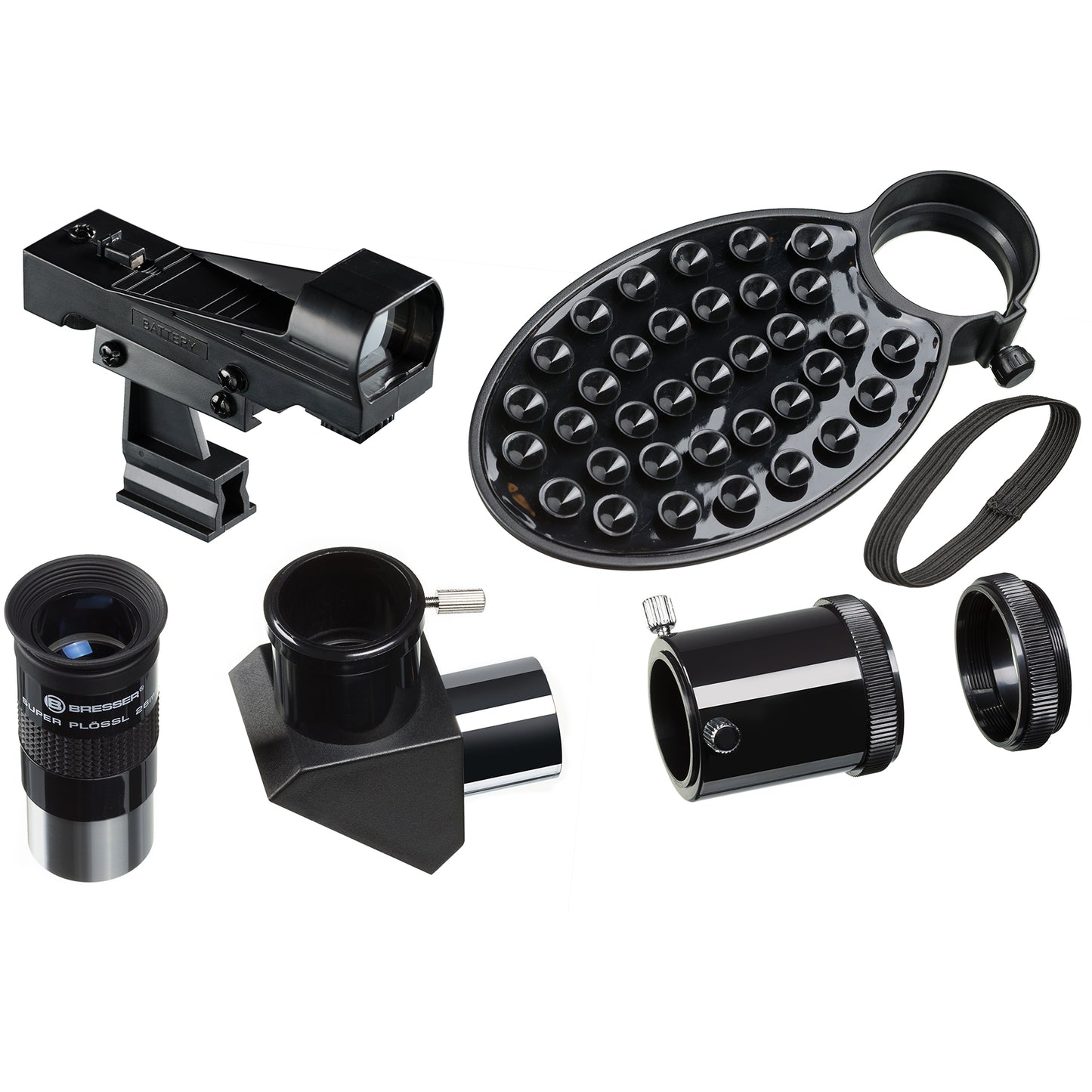
The Bresser Nano AR-80/640 AZ telescope is a compact achromatic refractor with an objective diameter of 80 mm and a focal length of 640 mm, designed for observing the night sky and the Sun. The telescope is aimed at both beginners and those looking for a convenient and mobile tool for field observations. Thanks to its wide field of view, it is perfect for viewing large areas of the starry sky, open clusters and the Milky Way. The 80 mm aperture provides 31% more light compared to 70 mm refractors, which noticeably improves the clarity and detail of images. Complete with an objective solar filter, the telescope allows you to safely observe sunspots, eclipses and planetary transits. The NANO mount with azimuthal operating principle and a steel tripod make installation quick and convenient - the telescope is delivered almost fully assembled. The smartphone adapter and T2 ring unlock astrophotography possibilities right out of the box.
The flagship line of Nano telescopes from the German manufacturer Bresser is distinguished by high quality assembly, precision fitting of optical elements and the use of only high-quality materials. There are no compromises in quality and price. All components, parts, as well as lenses of the telescope are made with precision accuracy, which provides the best optical and operational characteristics in its class. Bresser Nano telescopes are well appreciated by experienced amateur astronomers.
What space objects can be observed with this telescope:
The Sun - using the objective solar filter included in the kit, you can safely observe sunspots, flares, transits of planets (Mercury and Venus) across the Sun's disk, as well as partial and total solar eclipses.
Moon - 80mm aperture and 160x maximum magnification allow for detailed viewing of craters, mountain ranges, seas and plains on the lunar surface. At 25x (26mm base eyepiece) the Moon appears in an impressively wide field of view.
Planets of the Solar System - Jupiter - visible cloud bands, the Great Red Spot and four large Galilean moons (Io, Europa, Ganymede, Callisto); Saturn - visible rings of the planet and the largest moon Titan; Mars - visible polar caps and large surface details during the opposition period; Venus - clearly visible phases of the planet, similar to the lunar ones; Mercury - phases of the planet are observed.
Deep Sky Objects:
Open star clusters — the Pleiades (M45), the Hyades cluster, the Perseus cluster (NGC 869/NGC 884) fit perfectly into the telescope's wide field of view.
Nebulae - the Orion Nebula (M42), the Lagoon Nebula (M8) are observed as extensive light clouds.
Globular star clusters—M13 in Hercules and M5 in Ophiuchus—stand out as dense balls of light.
Galaxies - the Andromeda Galaxy (M31) and the galaxies of the M81/M82 group are visible as elongated spots of light.
Milky Way - thanks to its short focal length and wide field of view, the telescope is perfect for viewing the dense star fields of the Milky Way.
Double stars—pairs such as Albireo (β Cygni) and Mizar/Alcor (ε Ursa Major)—are easily resolved at moderate magnifications.
Design features
- Achromatic refractor AR-80/640 - an achromat type optical scheme combines two...