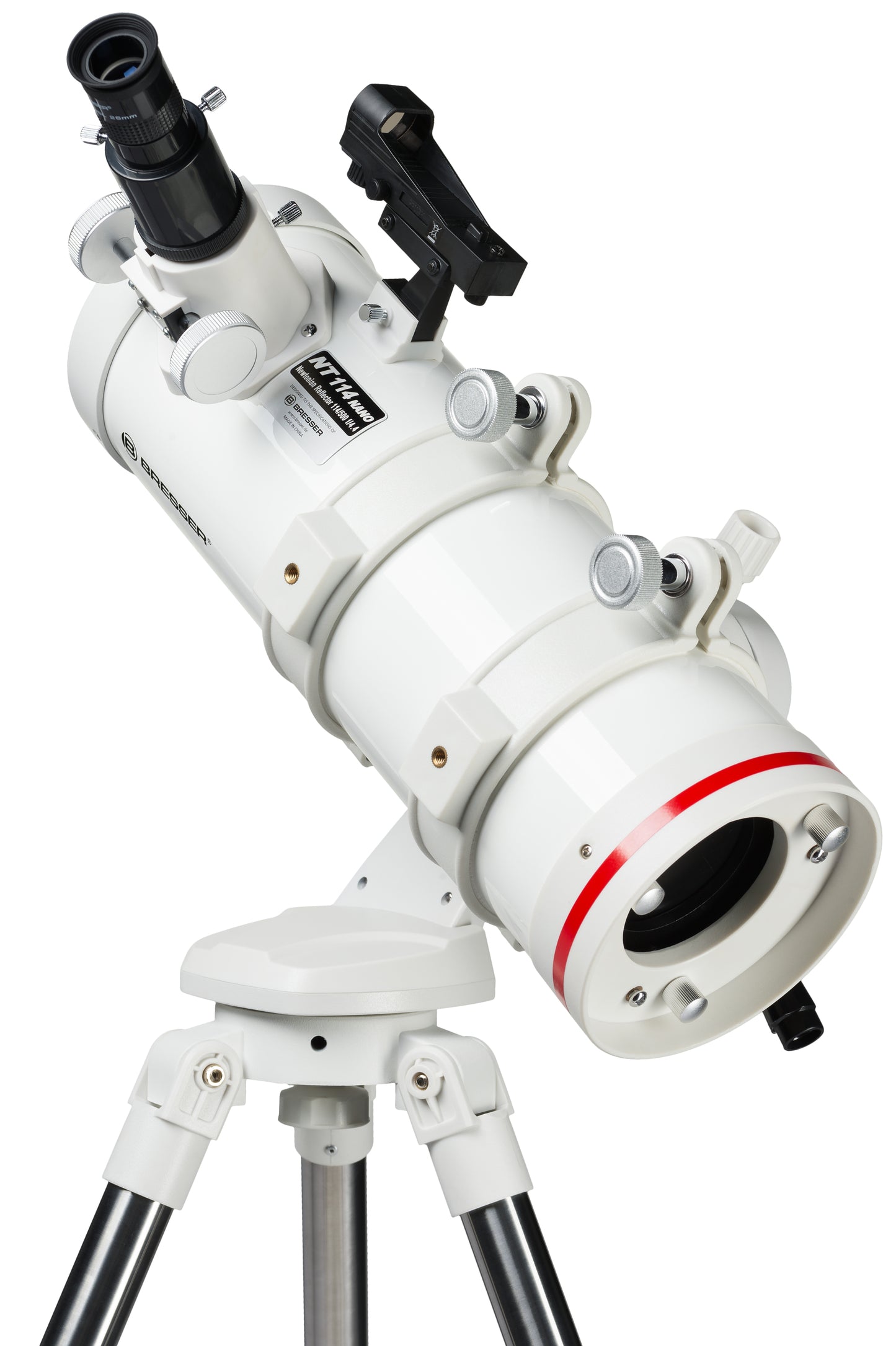
Description
The Bresser Nano NT-114/500 AZ telescope is a compact Newtonian reflector telescope with a main mirror diameter of 114 mm and a focal length of 500 mm, designed specifically for beginners in astronomy. Thanks to its short focal length and f/4.4 aperture, the telescope provides impressive wide-field observations, ideal for viewing open star clusters and panoramas of the Milky Way. The diffraction-limited main mirror guarantees maximum image clarity and a resolution of 1.21 arcseconds. The NANO azimuthal mount makes operating the telescope as easy as working with a photo tripod, which significantly reduces the time it takes to master the device. The kit includes an objective solar filter that allows you to safely observe the Sun, and a smartphone adapter opens up opportunities for astrophotography at no additional cost. The telescope is delivered almost fully assembled and ready to use, so you can start your first observations on the first evening. Compact dimensions and light weight make the Bresser Nano NT-114/500 an excellent choice as a travel telescope for observations outside the city.
The flagship line of Messier telescopes from the German manufacturer Bresser is distinguished by high quality assembly, precision fitting of optical elements and the use of only high-quality materials. There are no compromises in quality and price. All components, parts, as well as mirrors of the telescope are made with precision accuracy, which provides the best optical and operational characteristics in its class. Bresser Messier telescopes are well appreciated by experienced astronomy enthusiasts.
What space objects can be observed with this telescope:
Sun - sunspots, solar eclipses, planetary transits across the Sun's disk (only with the included solar objective filter)
Moon — 114 mm aperture gives a good level of detail. Craters, mountains, seas — all this is clearly visible at a magnification of 50–100×. Maximum recommended magnification — 228× craters, mountain ranges, seas, valleys and other details of the lunar relief; photographing the Moon through a T2 adapter
Planets - Jupiter with cloud belts and moons, Saturn - rings and Cassini division are clearly visible, Mars - polar cap in favorable opposition, Venus - phases, Mercury,
Deep Sky objects — open star clusters (Pleiades, Hyades, Perseus cluster), diffuse nebulae, Andromeda Galaxy (M31) — visible, without structural details, Orion Nebula (M42), Milky Way as a wide-field panorama
Design features:
- The Newtonian optical system is a classic mirror design in which a primary concave parabolic mirror collects light and reflects it onto a secondary flat mirror, which directs the image to an eyepiece on the side of the tube. This arrangement allows for a large objective diameter at a relatively low cost and without the chromatic aberrations inherent in lens telescopes. This makes the Newtonian reflector one of the most popular types of telescopes among beginners.
- Diffraction-limited primary mirror with a diameter of 114 mm — the primary mirror is manufactured with such precision that the only limitation on image clarity is the physical limit of light diffraction, not manufacturing errors. This means that the optics fully realize the theoretical potential of the 114 mm aperture, providing a resolution of 1.21 angular...