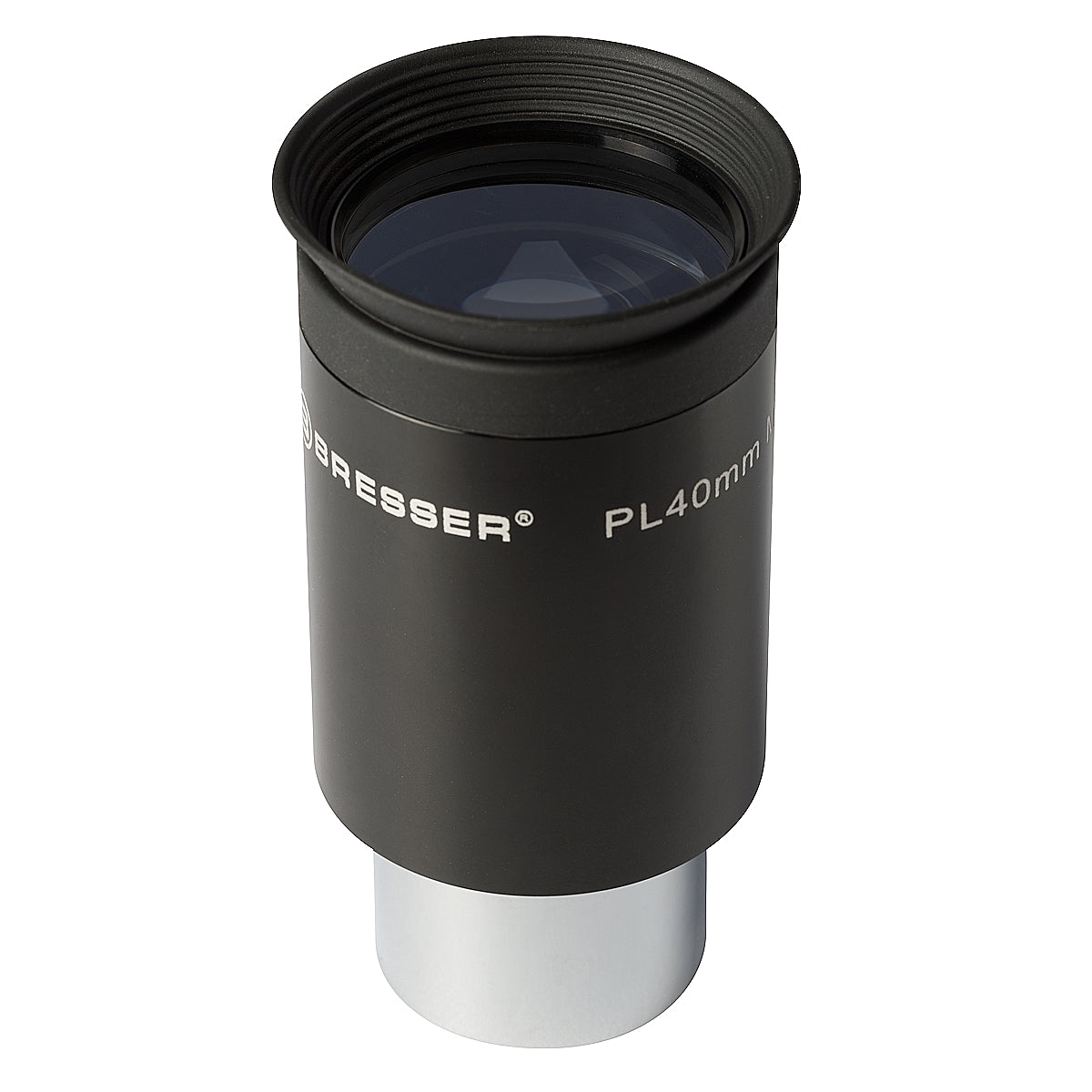
Description
The BRESSER Plössl 40 mm eyepiece is a classic 4-lens eyepiece with a standard mounting diameter of 1.25" (31.7 mm), designed for observations at the lowest magnification with the widest possible field and very comfortable viewing. Thanks to the Plössl scheme, it provides a sharp, high-contrast image, noticeably better than simple eyepieces of the Kellner and Huygens types. The focal length of 40 mm provides the lowest magnification in the line - ideal for searching for objects, surveying panoramas of star fields and covering large clusters. The main advantage of this eyepiece is its large pupil distance, which makes observation particularly comfortable, especially for those who wear glasses. All lens surfaces have full multi-layer illumination, and the all-metal housing without plastic ensures durability. The eyepiece is best used on telescopes with a long focus (f/8 and above), where it provides an exit pupil that matches the eye. On very fast In reflectors (f/4–5), the exit pupil becomes too large, so shorter eyepieces are better suited for them. The filter thread allows you to screw color and fog filters directly into the eyepiece.
Magnification on typical telescopes (telescope focal length ÷ 40 mm)
On a 700 mm telescope - 17.5x (Venus 76/700, First Light, Junior series)
On a 900 mm telescope — 22.5x (Sirius 70/900, Taurus 90/900)
On a 1000 mm telescope — 25x (Messier NT-203/1000, AR-102/1000)
On a 1200 mm telescope — 30x (Messier NT-150L/1200, AR-127L/1200)
On a 1525 mm telescope — 38x (Messier 12" Dobson)
Pay attention to the exit pupil (40 mm ÷ telescope aperture): at f/9–13 it is a comfortable 3–4 mm, and at f/4.6–5 it increases to 8–9 mm, due to which part of the aperture is not used by the eye. Therefore, this eyepiece is optimal for long-focus refractors and slow reflectors.
Design features
- The focal length of 40 mm determines the lowest magnification among the eyepieces of this line. This is a classic "surveying" range for searching for objects, panoramas of the Milky Way and covering large open clusters in one field. The eyepiece becomes a basic tool for initial aiming before moving on to more detailed magnification. The user gets the widest possible view of the starry sky.
- Large pupil distance - due to the long focal length, the distance from the eye to the eyepiece lens in this eyepiece is the largest in the line. This makes observation very comfortable and allows you to watch without having to squeeze too close. The eyepiece is comfortable even for those who observe with glasses, without losing their field of vision. The user does not get tired during long sessions.
- The Ploszl scheme (4 lenses in 2 groups) is a classic symmetrical four-lens design that produces a sharp image with good correction of field aberrations. It provides noticeably higher quality than simple Kellner or Huygens glasses from budget sets. The image remains sharp almost to the edge of the field of view. The user immediately sees the difference in detail and contrast.
- Fully multi-coated — all air surfaces of all lenses are multi-coated. They minimize light reflection and ghosting inside the eyepiece. This allows more light to pass through the eyepiece, increasing contrast and brightness. The user gets a clearer image without haze around bright objects.
- The apparent field of view of 46° is the angular size of the image that the eye sees through the eyepiece. For a 40mm Ploszl, this is a slightly narrower field than for shorter models (50°), which is the norm for this focal length. The actual field of view is limited by the 1.25" body, so it is approximately the same as a 32mm eyepiece, but at a lower magnification. The user gets the widest possible true view, d...