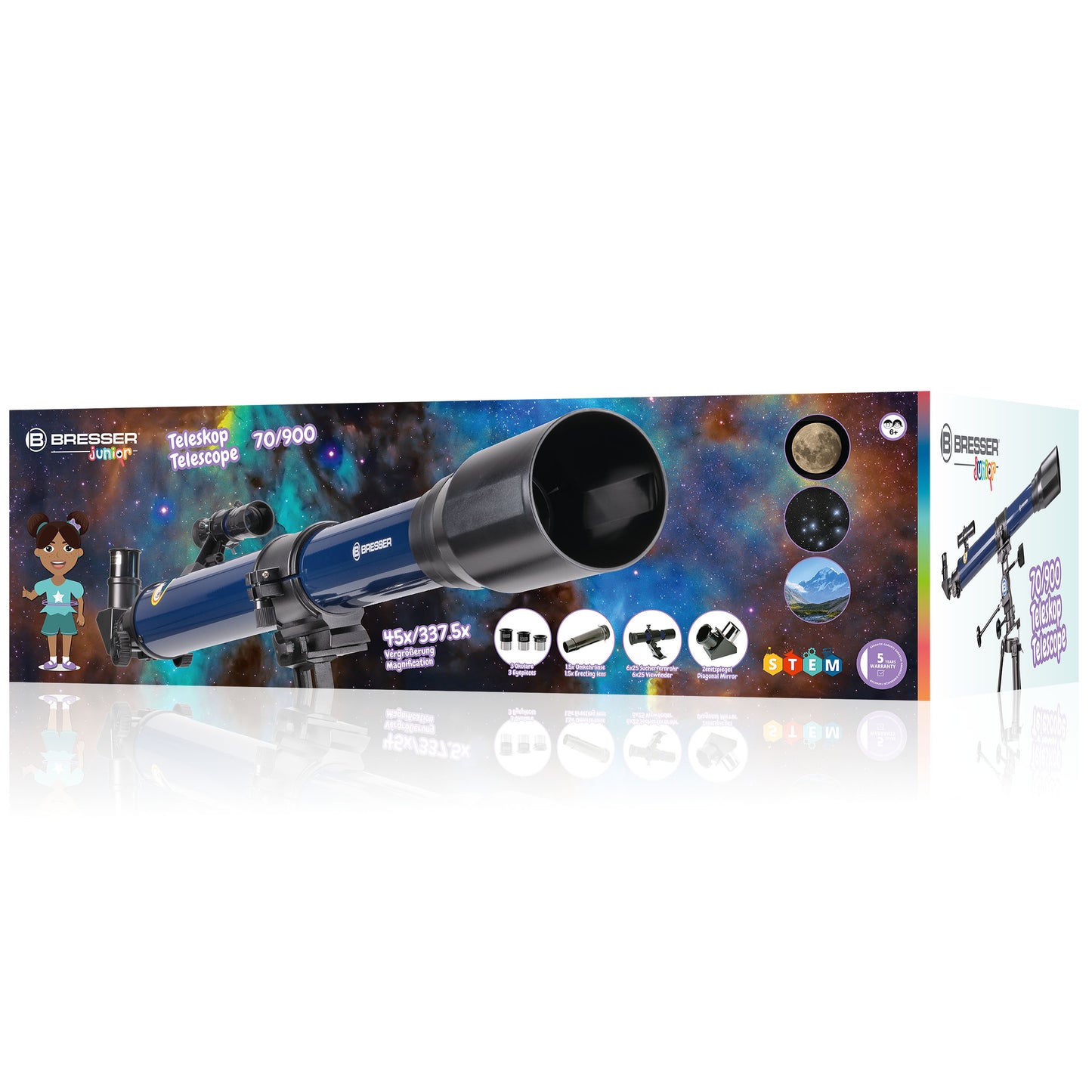
Description
The BRESSER JUNIOR 70/900 EL telescope is an achromatic lens refractor with an aperture of 70 mm and a focal length of 900 mm on a dual-mode mount, intended as the first serious instrument for young astronomers and beginners. The very long f/12.9 aperture gives a sharp, high-contrast image of the Moon and planets with minimal color fringing. The 70 mm aperture collects approximately 100 times more light than the human eye, revealing lunar craters, Saturn's rings, Jupiter's bands and the brightest clusters. The main feature is the mount, which works both in azimuthal mode (simple pointing up-down and left-right), and in equatorial mode thanks to the built-in wedge, as in adult observatories. The second is a rich starter kit with three eyepieces (4, 12, 20 mm), a 6x25 optical viewfinder, a zenith diagonal and a 1.5x direct-rotating lens. The third is an ultra-low weight of only 1.4 kg, thanks to which a child can independently carry and install the telescope on a balcony or in the garden. The 1.5x direct-rotating lens gives a correctly oriented image, so during the day the telescope serves as a telescope for observing nature. The kit also includes a planetarium program for a PC, which helps to orientate yourself in the sky before observing.
About the Bresser brand
Bresser was founded in 1957 by Josef Bresser in Rhede (Germany), and today it is one of the leading European manufacturers of optical instruments. A special place in the brand's assortment is occupied by telescopes - from affordable models for beginners to serious refractors, reflectors and mirror-lens systems for experienced amateur astronomers. Bresser has its own developments in the field of astronomical optics, mounts and accessories, and is also the owner of the well-known American brand Explore Scientific, which strengthens its position in the telescope market. In addition to astronomical equipment, the company produces microscopes, binoculars, spotting scopes and weather stations, combining a German engineering approach with an affordable price.
What space objects can be observed with this telescope?
Sun (requires a separate solar filter, e.g. Explore Scientific Sun Catcher 60-80 mm, art. 0310310 - not included; never look at the Sun without a filter):
Sunspots - individual spots with a dark core and their groups. Granulation - a granular surface structure in a fairly calm atmosphere. Partial phases of solar eclipses.
The Moon (the most grateful object for this telescope):
Large craters with central hills - Tycho, Copernicus, Clavius. Lunar seas - Sea of Tranquility, Sea of Rain, Ocean of Storms. Mountain ranges and valleys - Apennines, Alpine Valley. Terminator - the line of day and night with a distinct play of shadows, where the relief appears most prominently. Rays from young craters.
Planets:
Saturn - rings visible as a distinct "ear" around the disk. Jupiter - two main cloud bands and four Galilean moons (Io, Europa, Ganymede, Callisto), which change position every night. Venus - changing phases from crescent to almost full disk. Mars - as a small orange disk during oppositions. Mercury - crescent phases.
Deep Sky objects — the brightest objects available:
Open clusters - Pleiades (M45), "Manger" (M44), Double cluster in Perseus. Globular cluster M13 in Hercules as a hazy bright ball. Great Orion Nebula (M42) with a luminous core. Andromeda Galaxy (M31) - as an elongated bright spot. Double stars - golden-blue contrast Albireo.
Daytime ground observations:
With the included 1.5x prime lens, the telescope provides a correctly oriented image and serves as a spyglass for observing nature, birds, and landscapes.
Design features
- Achromatic objective 70 mm &mda...