Description
The BRESSER Messier AR-127L/1200 telescope is an achromatic lens refractor with an aperture of 127 mm and a focal length of 1200 mm on a stable German equatorial EXOS-2 mount, designed for highly detailed observations of the Moon, planets, the Sun and bright objects in deep space. The long f/9.4 aperture and the absence of a central shielding provide a sharp, high-contrast image, in which the cloud belts of Jupiter, craters of the Moon and the polar caps of Mars are clearly visible. The closed optical scheme does not require adjustment, so the telescope is ready for operation immediately and retains its settings for years. The device is aimed at both beginners and experienced amateurs, and is also suitable for daytime terrestrial observations as a powerful telescope. The first key feature is a high-quality achromatic objective with modern multilayer illumination, which provides a bright and contrasting image with minimal chromatic aberration for an achromat due to the long focus. The second is a professional HEXAFOC focuser with a free inner diameter of 2.5", which does not screen the beam and maintains rigidity under the weight of the camera. The third is a rigid EXOS-2 equatorial mount with ball bearings, manual precise guidance and readiness for automatic GoTo guidance. The kit already includes an aperture solar filter, an 8x50 viewfinder, an anti-reflection mirror and a smartphone adapter for navigating the sky.
About the Bresser brand
Bresser was founded in 1957 by Josef Bresser in Rhede (Germany), and today it is one of the leading European manufacturers of optical instruments. A special place in the brand's assortment is occupied by telescopes - from affordable models for beginners to serious refractors, reflectors and mirror-lens systems for experienced amateur astronomers. Bresser has its own developments in the field of astronomical optics, mounts and accessories, and is also the owner of the well-known American brand Explore Scientific, which strengthens its position in the telescope market. In addition to astronomical equipment, the company produces microscopes, binoculars, spotting scopes and weather stations, combining a German engineering approach with an affordable price.
What space objects can be observed with this telescope?
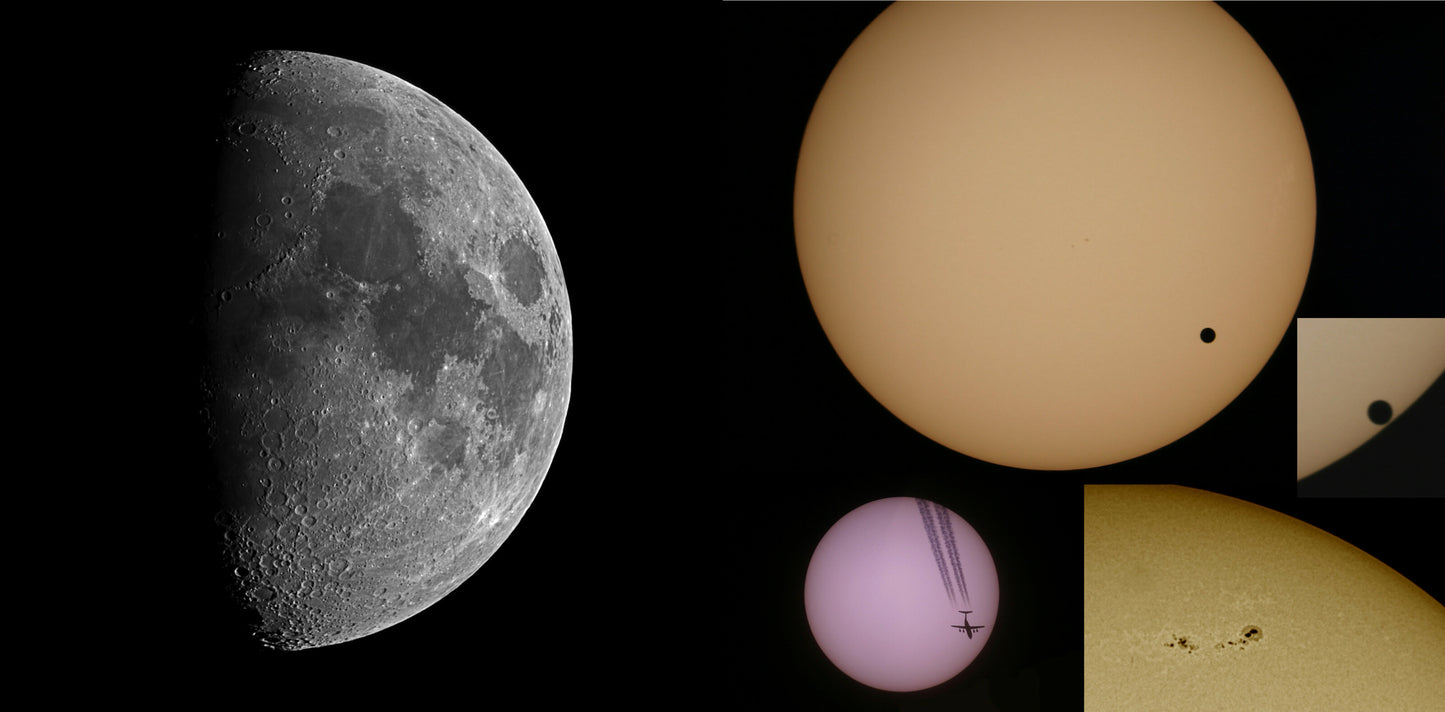
Sun (only with the aperture filter included in the kit, observation in white light):
Sunspots - individual spots with a dark core and penumbra and their groups, noticeable change from day to day. Flares - brighter areas of the photosphere near the spots closer to the edge of the disk. Granulation - a granular surface structure when the atmosphere is quite calm. Transits of Mercury and Venus across the disk of the Sun. Partial phases of solar eclipses.
Moon (one of the strongest refractor directions due to contrast):
Large craters with central hills - Tycho, Copernicus, Clavius, Plato. Lunar seas - Sea of Tranquility, Sea of Rain, Ocean of Storms. Mountain ranges and valleys - Apennines, Caucasus, straight Alpine valley. Terminator - line of day and night with a distinct play of shadows, where the relief appears most prominently. Thin terraces on the walls of craters and small craters due to the high contrast of lens optics.
Planets (profile direction of this telescope):
Jupiter - cloud belts and zones, Great Red Spot, four Galilean moons (Io, Europa, Ganymede, Callisto) and their shadows on the disk. Saturn - rings, Cassini division in a calm atmosphere, moon Titan. Mars - polar cap and dark surface details during oppositions. Venus - changing phases from crescent to almost full disk. Mercury - crescent phases. Uranus - as a tiny greenish-blue disk outside Saturn's orbit.
Deep Sky Objects:
Globular clusters - M13 in Hercules and M5, partially separated at the edges, as well as M15, M92. Open clusters - Pleiades (M45), "Wild Duck" (M11), Double Cluster in Perseus. Diffuse nebulae - Great Orion Nebula...